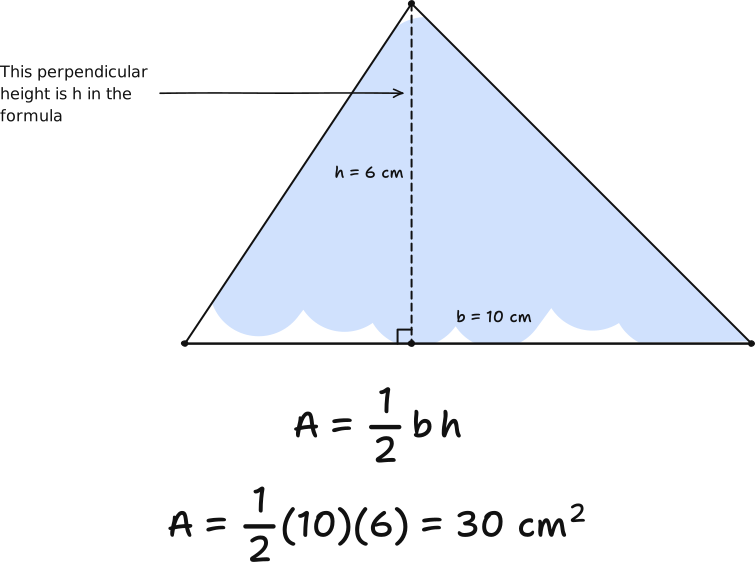
Human tutors almost never teach with words alone. They grab a piece of paper, pull a student to the whiteboard, and draw the thing they are trying to explain.
That is not decoration. Spatial structure is how a lot of understanding actually happens: a cycle with arrows, a triangle with squares on its sides, a timeline, a map of a cell. If an AI tutor cannot do this, it is missing one of the most basic teaching moves a human has.
This is worth building because visual explanation is not a nice-to-have on top of chat. For many subjects, the diagram is the explanation.
What we want. A tutor that can think with a pen. Something that can sketch a structure, label the parts, build the drawing in the order a student should notice it, and leave a picture behind that the student can point at.
What currently gets produced. Chatbots produce paragraphs. Sometimes they dump a code-drawn diagram that looks like a flowchart generator. Sometimes they generate an image: static, often slightly wrong, and finished all at once. The student is left reading about a picture instead of watching one get made.
Why that's the case. The default medium is a text box. Models are trained to complete text. Image generation is built to produce a finished picture, not a teaching sketch that unfolds. There is no shared surface in the interaction, so there is nothing to draw on. The product never asked the model to teach with a pen, so it never learned to.
The solution is to give the AI a canvas: a sheet of paper in the interface that it can actually draw on.
Not a generated illustration pasted into the chat. A surface it sketches on, stroke by stroke, the way a tutor would. The student watches the explanation get constructed. They can pause it, point at a part, and ask a question about that part.
How it works. The tutor has a drawing tool. When a visual explanation would teach better than a paragraph, it uses the canvas instead of, or alongside, text. It draws in a teaching order: first the structure, then the relationships, then the labels. The finished sketch stays on the page as something the session can keep referring to.
Pros. It matches how a lot of teaching actually happens. It makes sequence visible: you see the idea assembled, not just the final picture. It gives the student something to point at. It works in the flow of a session instead of sending them to another tab. And because the drawing is structured, not a bitmap, you can restyle it, inspect it, and reuse it.
Cons. Not every topic wants a sketch. Diagrams can still be wrong, and a wrong diagram is worse than a vague paragraph because it looks authoritative. Generating good drawings is harder than generating prose. There is a latency problem: a sketch that takes too long to start feels broken. And a 2D line drawing will not replace a simulation, a video, or a physical model.
Why this is specific to education. In most work tools, the picture is an output. You want the finished graphic. In education, the construction of the picture is the lesson. Watching the arrows appear in order is the teaching. That is a different product than an image generator, and it is not worth the tradeoffs for a general assistant. You also have a constrained visual vocabulary: the diagrams school actually uses. That constraint is what makes this tractable. A general-purpose drawing agent has to draw anything. An education canvas mostly has to draw the kinds of pictures teachers already draw on paper.
Video explainers. The same drawing system can produce short explainer sequences: a sketch that builds while a voice talks over it. These can be generated for a specific student, at a specific point in a course, instead of searching for a YouTube video that is almost right.
In-chat responses. Inside a tutoring session, some turns should not come back as a paragraph. They should come back as a sketch in the thread. The chat remains the spine of the session; the canvas is what the tutor reaches for when words are the wrong medium.
Live tutor and shared canvas. The strongest version is a shared surface. The tutor draws. The student can draw too: circling a part they do not understand, attempting the next step, correcting a label. That is closer to sitting next to someone with a piece of paper than it is to sending messages back and forth.
It is tempting to skip the humble version and go straight to generated video, 3D simulations, and interactive worlds. Those will matter. But the first job is to give the tutor the tools a human already has.
A human tutor with a pen and paper is already an extraordinarily good teaching interface. If the AI cannot do that yet, it is not ready for the science-fiction version. Mimicry is not a lack of ambition. It is how you find out which parts of teaching were load-bearing.
Once the mimic is in place, then you innovate past the human: drawings that animate into simulations, sketches that become quizzes, a canvas that can fork into three versions of the same diagram at different levels of abstraction. Innovation on top of a real teaching primitive, not instead of one.
A human tutor is not a language model. They have a body in the room: a voice, a pointing hand, a pen, eyes that notice confusion, the ability to slide a piece of paper across the table.
An AI tutor will not match that, and it does not need to. It can be infinitely patient. It can redraw the same picture ten ways. It can remember every sketch it has ever made for this student. It cannot sit beside them, see their face, or pick up on the pause before a wrong answer the way a person can.
So the work is not to impersonate a human. It is to give the AI a small set of primitives that cover what a human tutor does with their body. A canvas is one: the pen. Others are eyes (seeing the student's work), a voice, a way to test, a way to point at the student's textbook. The canvas is not the product. It is one organ in an embodied tutor, the part that lets it explain by drawing.